
Salt Lake County Family Court Records
Salt Lake County family court records cover divorce, child custody, child support, paternity, adoption, and guardianship cases filed in the Third Judicial District Court. With over 1.2 million residents, Salt Lake County is the most populous county in Utah, and its district court handles more family law filings than any other court in the state. This page explains how to search family court records in Salt Lake County, what those court documents contain, and where to find legal help when you need it.
Salt Lake County Quick Facts
Salt Lake County Family Court Records Access
Residents and researchers have several ways to access family court records in Salt Lake County. The most direct method is an in-person visit to the Scott M. Matheson Courthouse at 450 South State Street, Salt Lake City, UT 84114. The clerk's office can look up case files by party name or case number, provide plain copies, and issue certified copies of orders and decrees. Public access terminals inside the courthouse connect to XChange, the Utah courts' subscription-based record system, at no charge during your visit.
XChange is available online through utcourts.gov for those who register. Individual searches and monthly subscriptions are both offered. The Utah State Law Library in Salt Lake City also provides free XChange terminals to the public. For parties who have an active case, the MyCourtCase portal gives free access to your own case information, including hearing dates, document lists, and payment records, without needing a subscription.
Written records requests under the Government Records Access and Management Act (GRAMA), Utah Code § 63G-2, may also be submitted to the Third District Court clerk's office. The court has up to 10 business days to respond, as set by Rule 4-202 of the Utah Rules of Judicial Administration. Mail or in-person delivery both work for GRAMA requests in Salt Lake County.
Note: The courthouse phone number is (801) 238-7300. Hours are generally Monday through Friday, 8:00 AM to 4:30 PM, but call ahead before making a trip to confirm current hours.
Having a case number or party name ready before visiting the courthouse will speed up the lookup process significantly.
Knowing the case number before your visit speeds up the search process and reduces wait time at the clerk's counter.
Third District Court in Salt Lake County
The Third Judicial District Court is the largest state trial court in Utah. It sits at the Scott M. Matheson Courthouse and handles all general jurisdiction matters for Salt Lake County, including divorce, child custody, child support, paternity, adoption, guardianship, and protective orders. The court also handles civil, criminal, and probate cases under the same roof.
The Third District has a separate juvenile court division. The Juvenile Court handles matters involving minors, including delinquency, abuse and neglect, and termination of parental rights. Those family case records are largely restricted from public view to protect minors, though parents and attorneys may access their own case files. Probate matters, such as guardianship of adults and estate proceedings, are also part of the Third District's jurisdiction in Salt Lake County.
Several justice courts operate within Salt Lake County alongside the district court. The Salt Lake City Justice Court at 333 South 200 East handles misdemeanor and traffic matters. The Salt Lake County Justice Court is at 2001 South State Street, Suite S4-300, phone (801) 487-7200. Municipal courts in Sandy, West Valley City, and other cities also serve local misdemeanor and traffic cases. Justice courts do not handle family law or divorce matters; those always go to the Third District Court.
The Third Judicial District Court's official page on utcourts.gov lists current hours, courtroom assignments, and clerk contact details.
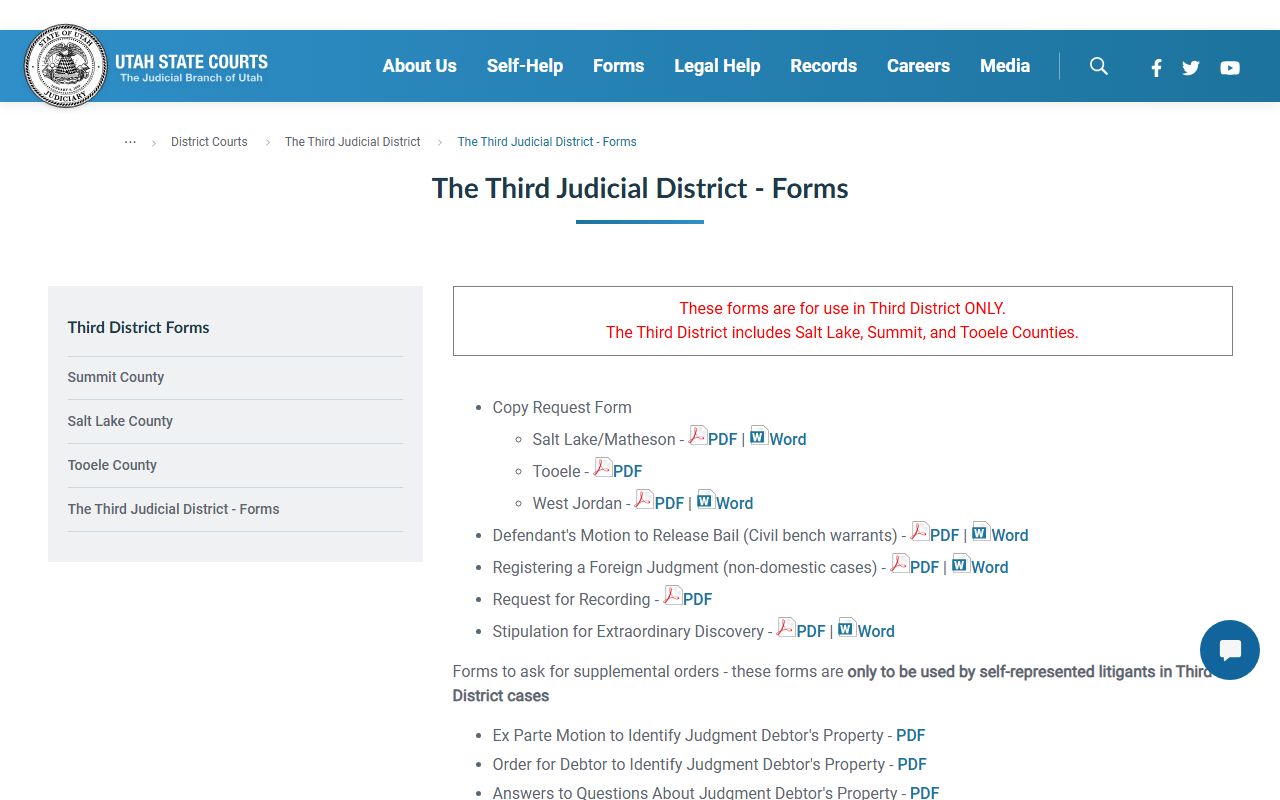
Bookmark that page to stay current with any changes in court schedules or clerk hours for Salt Lake County.
Types of Family Court Cases in Salt Lake County
The Third District Court processes a wide range of family law cases each year. Divorce, formally called dissolution of marriage, is the most common. Under Utah's new domestic relations code, Title 81 (effective September 1, 2024), divorce law was recodified from Title 30. The waiting period before a court can finalize a divorce is 30 days when no minor children are involved, or 90 days when minor children are part of the case.
Child custody is determined by the best interests of the child standard under § 81-9-202. Judges weigh factors including each parent's bond with the child, the ability to provide stability, and the child's own preferences when the child is mature enough to express them. Physical custody, legal custody, and parent-time schedules are all addressed within the same family law case. The default optional parent-time schedule under § 81-9-303 provides 145 overnights per year to the non-primary parent.
Other common family court case types in Salt Lake County include child support orders and modifications, paternity actions, adoptions, step-parent adoptions, guardianship petitions, protective orders in domestic cases, and grandparent or third-party custody petitions. Each type creates its own set of court documents and case files at the Third District Court.
Salt Lake County Family Court Records: What They Contain
Family court records in Salt Lake County include all documents filed with the Third District Court clerk from the start of a case to its close. The initial complaint or petition is the first document. It names the parties, states what relief is sought, and opens the case. The responding party's answer, any counter-petitions, and temporary orders that follow are all part of the case file.
Orders and final decrees are the most commonly requested family court documents. A divorce decree, for example, sets out the terms of the dissolution, property division, spousal support if any, and all arrangements for any children. These decrees are public records. Anyone may request a copy from the clerk's office. Certified copies carry the court's stamp and are accepted for legal purposes such as name changes or property transfers.
Understanding which document you actually need, such as a decree versus a certified copy of a specific order, saves time when you contact the clerk's office.
Understanding which document you actually need, such as a decree versus a certified copy of a specific order, saves time when you contact the clerk's office.
Some family court records are restricted in Salt Lake County. Adoption case files are sealed under state law, meaning only the parties and their attorneys can access them without a court order. Juvenile court records are similarly protected. Mental health evaluations ordered by the court, records in cases involving domestic violence victims, and any records the judge has formally sealed are not available to the general public. Utah Constitution Article I, Section 11 guarantees open courts as a general principle, but specific statutes and court rules carve out these exceptions to protect privacy.
Note: Dissolution of marriage filings are classified as private records under Utah law, but the resulting orders and decrees remain public. Parties and attorneys always have full access to their own case files.
Salt Lake County Historical Court Records
Salt Lake County has some of the oldest court records in Utah. The Third District Court's civil and criminal records date back to 1852, when Utah was still a territory. Probate case files from as early as 1906 through 1925 are also preserved. These older family case records and court filings are not available through XChange. Instead, researchers look to the Utah State Archives for access.
The Utah State Archives is located at 346 South Rio Grande Street, Salt Lake City, UT 84101. The archives research page explains how to submit requests for historical court records, including old divorce cases, probate files, and civil judgments. Some records have been digitized, while others require an in-person visit or a mail request. Salt Lake County's long history means the archives hold a substantial collection of family law filings from the territorial and early statehood periods.
For records from the mid-1900s onward that are not yet in the archives, the clerk at the Matheson Courthouse can direct you to the correct storage location. Older files may be in off-site storage and could require additional time to retrieve. Planning ahead helps when researching historical family court records in Salt Lake County.
Note: The archives do not charge per-page search fees to identify whether a record exists, but copy or retrieval fees may apply depending on the format and age of the record.
Related Salt Lake County Records
Family court cases often connect to other records in Salt Lake County. Marriage records, for example, may be needed to prove the legal marriage before a divorce decree can be issued. The Salt Lake County Clerk's office at 2001 South State Street handles marriage licenses for the county. Property records managed by the Salt Lake County Recorder at the same address often reflect changes that flow from divorce decrees, such as deed transfers and lien releases.
Probate records at the Third District Court can also intersect with family law matters, especially in cases involving the death of a spouse or guardianship proceedings. The probate division at the Matheson Courthouse can be reached at (801) 238-7164. Older probate records from 1906 to 1925 are held at the Utah State Archives. Current probate case records are searchable through XChange using the same login used for family court records.
Probate and family court records are both searchable through XChange using the same login, making it easy to review both record types during a single research session.
Probate and family court case files often need to be reviewed together when settling estates that involve child support obligations or spousal support orders still in effect at the time of death.
Legal Help for Family Court Cases in Salt Lake County
Navigating family court in Salt Lake County is easier with the right support. Several resources exist for people who need help with their case, whether they plan to represent themselves or hire an attorney.
Utah Legal Services provides free civil legal assistance to qualifying low-income residents of Salt Lake County. Their attorneys handle family law matters including divorce, custody, and protective orders. Visit utahlegalservices.org to check eligibility and apply. The Utah State Bar runs a lawyer referral program that can connect you with a licensed family law attorney in Salt Lake County. Call (801) 531-9077 to use the referral line.
The Utah Courts website at utcourts.gov hosts court forms and instructions through the Online Court Assistance Program (OCAP). OCAP guides users through filling out common forms for divorce and custody cases step by step. This is a particularly useful tool for self-represented parties in Salt Lake County who are filing without an attorney. The forms generate properly formatted documents ready for filing at the Third District Court clerk's office.
For parties who qualify based on income, a Petition to Proceed In Forma Pauperis allows the court to waive or defer filing fees. Ask the clerk's office for the form, or download it from the Utah Courts forms page. The Open Courts Compendium for Utah published by the Reporters Committee for Freedom of the Press is another reference that explains public access rights to court records under Utah law.
Note: The Utah State Law Library in Salt Lake City offers free public access to legal databases and has staff who can help you locate legal resources, though they cannot provide legal advice.
Cities in Salt Lake County
Salt Lake County includes dozens of cities and communities, all served by the Third District Court for family law matters.
Nearby Counties
Salt Lake County borders several other Utah counties. If you are unsure which court has jurisdiction over your case, confirm the county of your residence before filing.