
Salt Lake City Family Court Records
Salt Lake City family court records are filed and maintained at the Salt Lake County District Court, the Third Judicial District. Salt Lake City is Utah's state capital and its largest city, home to roughly 200,000 residents. The city sits at the heart of the most active court district in the state. Cases covering divorce, custody, child support, adoption, guardianship, protective orders, and paternity all go through this court. You can search Salt Lake City family court records online or in person at the Matheson Courthouse on South State Street.
Salt Lake City Quick Facts
Salt Lake City Family Court Location
All family court cases for Salt Lake City residents go through the Third Judicial District Court. The Matheson Courthouse is in downtown Salt Lake City, just a few blocks south of the state capitol. This is the largest state court in Utah. The court handles thousands of family law cases each year. The District Court Clerk keeps all case files and can provide copies of orders, decrees, and judgments.
| Court | Third Judicial District Court |
|---|---|
| Address | 450 South State Street Salt Lake City, UT 84114 |
| Phone | (801) 238-7300 |
| Hours | Monday through Friday, 8:00 AM to 5:00 PM |
| Website | utcourts.gov |
The courthouse is accessible by TRAX and is a short walk from several downtown parking garages. Security screens all visitors at the entrance. Bring a valid photo ID when you visit to request Salt Lake City family court records. The Utah State Law Library is also in this building. It offers free public access to the XChange system for searching court records, plus legal databases and research help for self-represented parties.
Salt Lake City also has a separate Justice Court that handles misdemeanor criminal cases, traffic violations, and small claims. That court is at 2001 South State Street, Suite S4-300, phone (801) 487-7200. Family law filings such as divorce and custody go to the District Court, not the Justice Court.
Salt Lake City Family Court Records Types
Family court records in Salt Lake City cover a wide range of case types. Each type creates its own set of court documents. Most orders and final decrees are public records under Utah Code § 63G-2, the Government Records Access and Management Act (GRAMA). Some records, such as adoption files and juvenile court records, are restricted by law.
The types of family court records maintained at the Salt Lake City courthouse include:
- Divorce and annulment cases
- Child custody and parent-time orders
- Child support orders and modifications
- Adoption proceedings and decrees
- Guardianship and conservatorship files
- Protective orders and stalking injunctions
- Paternity cases and voluntary declarations
Each case file can include petitions, responses, motions, hearing notices, court orders, and final decrees. The Salt Lake City court processes more family law filings than any other district in the state. That volume means a wide range of records are on file, some going back many years. The Utah State Archives holds older Salt Lake County court records from 1852 onward.
Note: Adoption records are sealed by law in Utah and can only be accessed through the court that issued the original decree or through a petition for disclosure.
How to Search Salt Lake City Family Court Records
The Utah Courts system gives you several ways to find family court records in Salt Lake City. Online tools work well for basic case lookups. In-person visits let you review full case files and get certified copies the same day.
The main online tool is XChange, the Utah court case management system. It covers all district and justice courts statewide, including Salt Lake City. XChange shows party names, filing dates, case status, document images, and hearing information. Access costs $30 per month for unlimited searches, or $0.15 to $0.35 per search for lower-volume users. You can register and search at utcourts.gov. Free public XChange terminals are available inside the Matheson Courthouse and at the Utah State Law Library on the same premises.
The Salt Lake City courts page at slc.gov/courts covers the Justice Court and links to related city resources. For district court family cases, the main portal remains the Utah Courts website. Parties to active cases can use MyCourtCase at no charge to view their own case documents, scheduled hearings, and real-time updates.
The Utah Court Assistance Program (OCAP) at utcourts.gov helps people fill out court forms step by step. It covers family law case types including divorce, custody, protective orders, and guardianship. The forms are free to prepare. A document preparation fee applies when you file. OCAP is especially useful for Salt Lake City residents who want to represent themselves.
Salt Lake City Court Resources
The Salt Lake City Justice Court website at slc.gov/courts provides local court resources, case lookup tools, and contact information for residents seeking family court information in Salt Lake City.
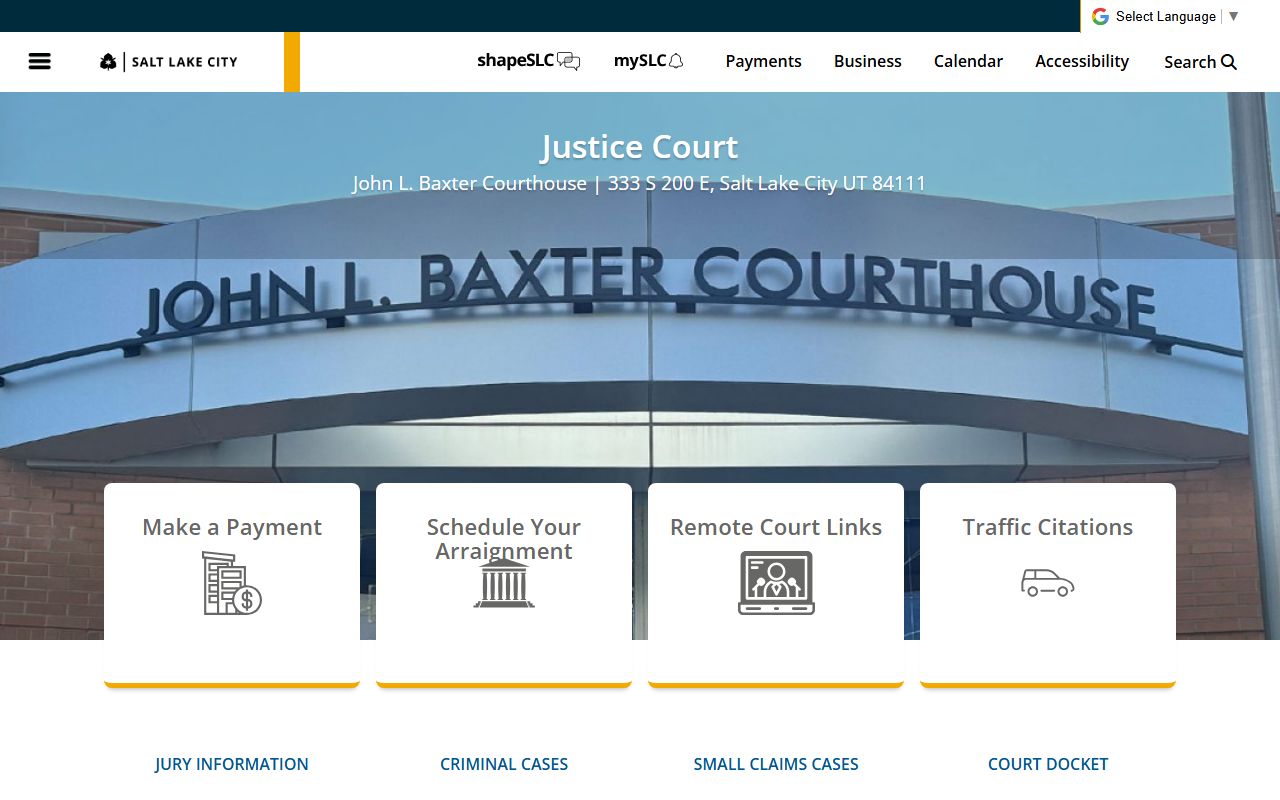
The Salt Lake City court portal helps residents find case status, pay fines, and access local resources tied to their family court matters in Salt Lake City.
Utah law changed significantly on September 1, 2024. The state moved its family law statutes from Title 30 to Title 81, the Utah Domestic Relations Code. The language and legal standards stayed the same. Only the numbering changed. Court orders issued before that date still cite Title 30, while orders entered after September 1, 2024 reference Title 81. If you are reading older Salt Lake City family court records, you may see both sets of citations.
Filing Family Court Cases in Salt Lake City
Salt Lake City residents file family court cases at the District Court Clerk's office in the Matheson Courthouse. The filing fee for a new divorce or family law case is approximately $330. Fees vary by case type. Call the court at (801) 238-7300 to confirm current rates before you file. If you cannot afford the fees, you may apply for a fee waiver by submitting the required petition form and proof of financial hardship. The court reviews the petition and decides if you qualify.
Divorce and separation cases require that at least one spouse has been a Utah resident and a Salt Lake County resident for at least three months before filing, as required by Title 81. Utah allows no-fault divorce based on irreconcilable differences. Fault grounds can still be cited and may affect alimony or other terms. The court imposes a mandatory waiting period: 30 days for cases without minor children and 90 days when children are involved.
Custody and parent-time decisions follow the best-interest standard set in Title 81, Chapter 9. The court weighs factors including each parent's moral character, ability to provide a stable home, any history of domestic violence or neglect, and the child's existing bond with each parent. Child support follows Utah's income shares formula. Protective orders can be filed at the courthouse or through the online OCAP system.
Note: Once filed, most orders and decrees in family court cases become public records. Salt Lake City residents may request copies of filed documents from the District Court Clerk during normal business hours.
Salt Lake City Family Court Legal Help
Utah Legal Services has offices serving Salt Lake City and the broader Salt Lake County area. They provide free civil legal help to qualifying low-income residents, including help with family court matters such as protective orders, custody, and divorce. Visit their website or call their intake line to check eligibility.
The Utah State Bar runs a lawyer referral service at (801) 531-9077. This can help Salt Lake City residents find a family law attorney for an initial consultation. The Utah Courts self-help center at utcourts.gov has step-by-step guides, video tutorials, and all required court forms for common family law cases. The Utah State Law Library in the Matheson Courthouse also provides free research assistance and public access to legal databases.
Accessing Records Under GRAMA in Salt Lake City
Utah's open records law, GRAMA (Utah Code § 63G-2), gives every person the right to inspect a public record free of charge and to get a copy during normal business hours. Court records in Salt Lake City are generally public under GRAMA, unless restricted by statute, court rule, or court order. The Utah Constitution, Article I, Section 11, also guarantees open courts as a matter of state law.
Rule 4-202 of the Utah Code of Judicial Administration governs how courts handle requests for access to court records. Under this rule, the court must respond to records requests within 10 business days, or 5 business days for expedited requests. If a Salt Lake City family court record is sealed or classified as non-public, a party can file a motion to access the record. The court must balance the interests favoring disclosure against the interests favoring closure and issue written findings.
Records restricted from public access in Salt Lake City family cases typically include adoption files, juvenile court records, mental health evaluations, records sealed by court order, and certain financial documents filed as exhibits. Public records include most final orders, decrees, and docket sheets. If you are unsure whether a specific record is public, contact the District Court Clerk at (801) 238-7300.
Salt Lake County Family Court Records
Salt Lake City is in Salt Lake County. All family court filings go through the Salt Lake County District Court. The county page covers the full court system, fee schedules, probate records, and additional resources for the entire county.
Nearby Utah Cities
Residents of nearby cities file family court cases at the courthouse that serves their area. Select a city below to learn more about family court records in that location.