
Grand County Family Court Records
Grand County family court records are maintained by the Seventh Judicial District Court in Moab, Utah. These case files cover divorce proceedings, child custody and parent-time orders, child support filings, paternity actions, adoption petitions, and protective orders filed in this eastern Utah county. You can search Grand County court documents in person at the Moab courthouse, through Utah's XChange online subscription service, or by submitting a formal GRAMA request. This page explains how each access method works and what information Grand County family case records typically contain.
Grand County Quick Facts
Grand County Family Court Records — District Court
Grand County was established in 1890 in eastern Utah, formed from land that was previously part of Emery County. The county seat is Moab, a city well known for outdoor recreation and its proximity to Arches and Canyonlands national parks. The Seventh Judicial District Court in Moab holds jurisdiction over all family law matters, felony criminal cases, civil disputes, and probate proceedings in Grand County.
The Seventh District Court is located at 125 West 200 South in Moab, Utah 84532. The clerk's office can be reached at (435) 259-1351. Staff are available Monday through Friday from 8:00 a.m. to 5:00 p.m. The court handles a range of domestic relations case types, and its records go back to the county's formation in 1890. A Justice Court also operates out of the same address and handles limited jurisdiction matters including misdemeanors, traffic violations, and small claims disputes, but does not hear family law cases.
Grand County family court records are public documents in most instances. Utah's open courts guarantee under Article I, Section 11 of the state constitution ensures that civil case files, including divorce filings, custody orders, and child support judgments, are accessible to any member of the public who requests them. The main exceptions are juvenile court records, sealed adoption files, mental health evaluation reports, and any file the court has placed under a sealing order. If a record has been sealed, the clerk will confirm its existence but will not provide access without a court order.
Note: Grand County is one of the largest Utah counties by land area accessible to the public. Despite its geographic size, its courthouse serves a relatively small population of around 10,000 residents, which keeps the volume of family court filings manageable for the clerk's office.
How to Search Grand County Family Court Records
The Seventh District Court page at utcourts.gov outlines the main search options available for family case filings in the Seventh District.
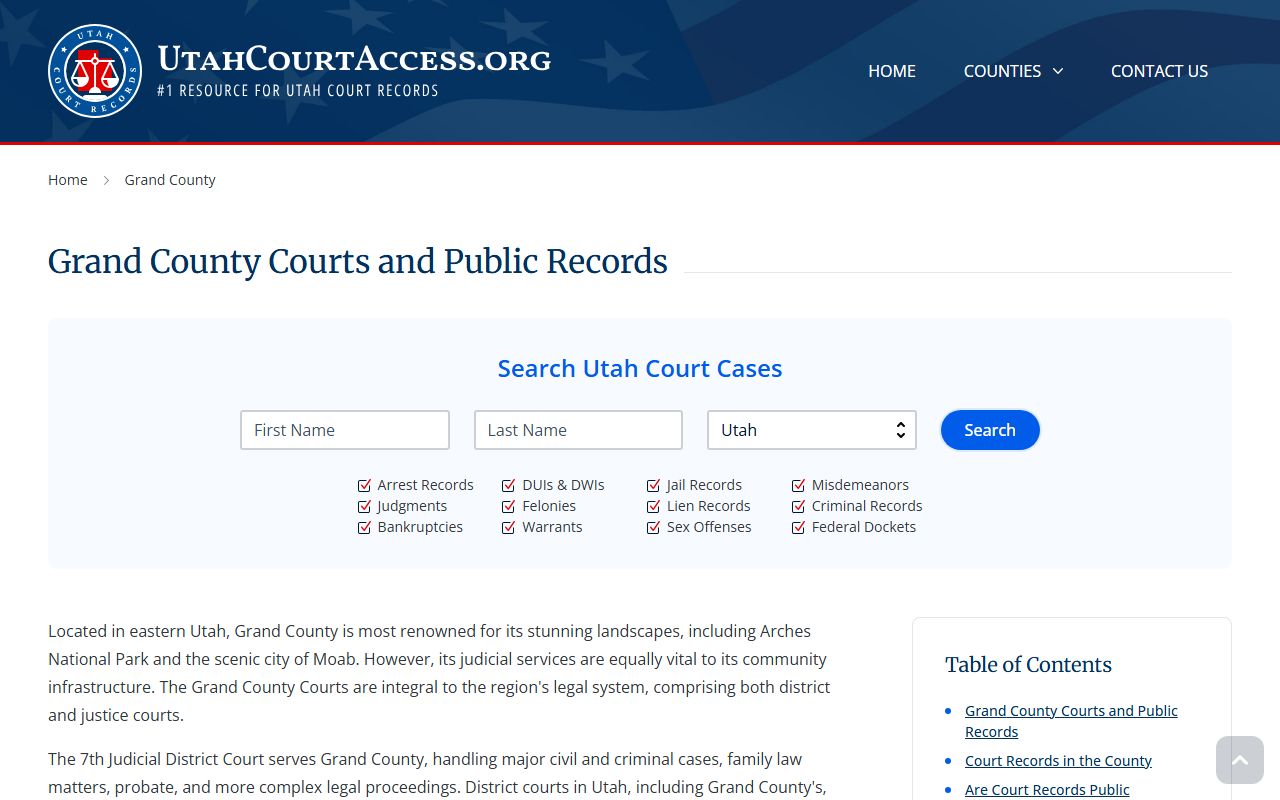
Several methods are available for searching Grand County family court records. The right approach depends on how quickly you need the information and how far you are from Moab.
In-person access at the Moab courthouse is the most direct option. Visit the Seventh District Court at 125 West 200 South during regular business hours. Free public terminals inside the courthouse connect to Utah's XChange database at no charge. You can search by the full name of any party to the case or by case number. Court staff can help you navigate the terminal, though they are not permitted to offer legal advice. For copies of documents, ask the clerk about the current per-page rate before requesting large files.
XChange, accessible through utcourts.gov, gives you remote access to Grand County court case information and documents. A subscription runs $30 per month, or you can pay per individual search. This system is practical for attorneys, researchers, and anyone searching from outside Moab who does not want to make the drive. The searchable fields include party name, attorney name, and case number. XChange covers current and recent case filings across all Utah district courts.
MyCourtCase at utcourts.gov/mycase/ lets parties to active cases view their own court documents online without paying for a subscription. If you are involved in an ongoing family law matter in Grand County, this free tool allows you to track new filings and review orders entered in your case in real time. Parties to closed cases may have more restricted access depending on case type and case status.
GRAMA requests provide a formal written pathway for those who prefer it or who need certified copies of specific records. Under Utah Code Section 63G-2, the court must respond to your written request within 10 business days. The full statute is at le.utah.gov. Direct your written request to the clerk of the Seventh District Court in Moab, describing the records you need as precisely as possible.
Family Court Cases in Grand County
The Seventh District Court in Moab handles a full range of domestic relations matters. Each case type follows its own filing and procedural rules, and each produces its own set of court documents that become part of the case record.
Divorce filings are the most common category of Grand County family court cases. A divorce file typically includes the initial petition, financial disclosure statements from both parties, any temporary restraining or support orders entered by the court, mediation records where applicable, and the final decree of divorce. When the divorcing couple has minor children, the file also contains a proposed parenting plan and, in contested custody situations, a custody evaluation prepared by a court-appointed evaluator. Utah imposes a 30-day waiting period for divorces with no minor children and a 90-day waiting period when children are involved.
Child custody and parent-time cases may be filed as part of a divorce action or as standalone proceedings. Grand County courts apply the best interests of the child standard under Utah Code Section 81-9-202 when deciding custody arrangements. The statute lists specific factors the court must consider, including the child's relationship with each parent, each parent's capacity to meet the child's physical and emotional needs, and the child's ties to school and community. When circumstances change after an order is entered, either parent may file a modification petition in the same case.
Paternity filings, child support cases, adoption petitions, and guardianship requests complete the family law docket in Grand County. Protective order matters are handled by the Seventh District Court and are part of the public record. Adoption files are sealed by law after the adoption is finalized and require a court order to open. Juvenile matters, including delinquency and child welfare cases, are handled through the juvenile court system and are not publicly accessible.
Grand County Historical Court Records
The Utah State Archives page for Grand County describes the historical naturalization records preserved from the county's early years.
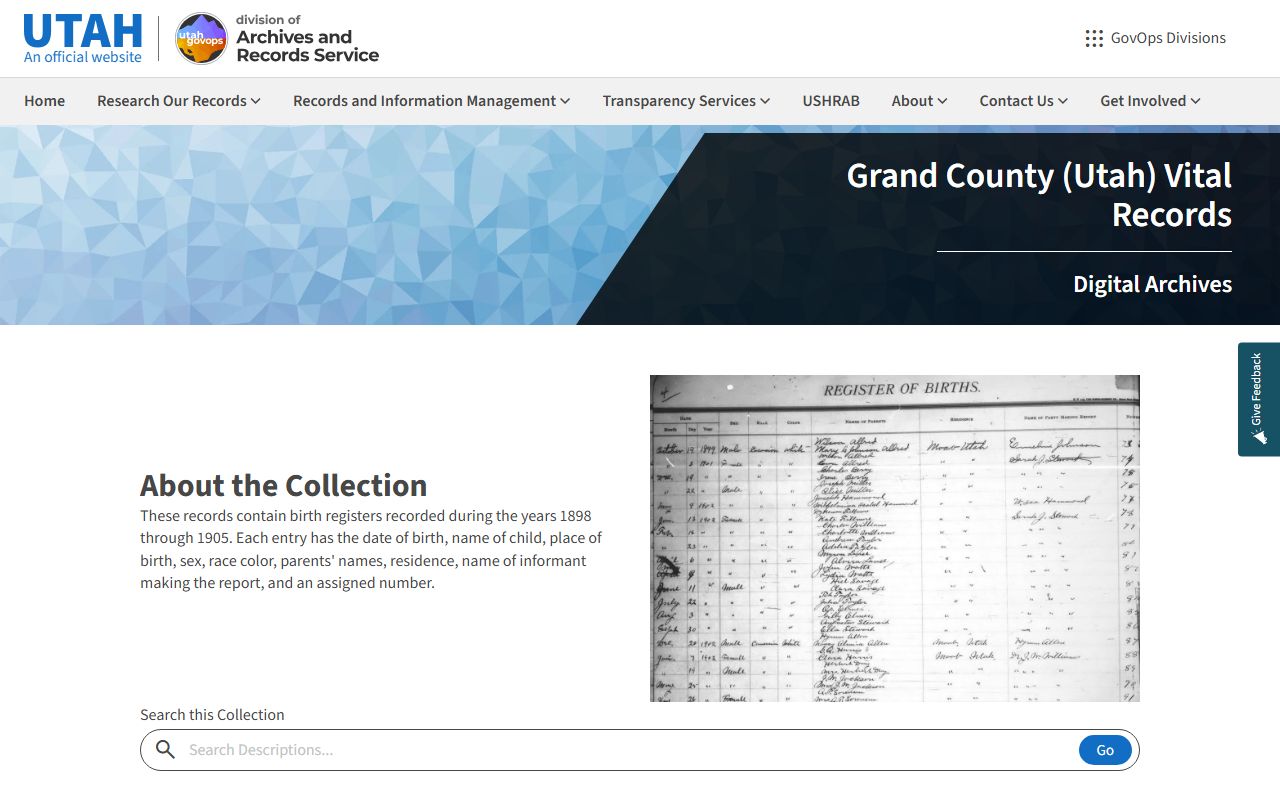
The Utah State Archives holds Grand County naturalization records covering the period from 1908 through 1929. These documents record the formal legal process by which immigrants resident in Grand County became United States citizens during the early twentieth century. Each file typically includes the applicant's full name, country of birth, date and port of arrival in the United States, and the date naturalization was granted. Researchers tracing family history in eastern Utah will find these records useful.
Grand County was established from Emery County in 1890, so court records from before that year would be found in Emery County's older record series rather than Grand County's. The Utah State Archives can help you identify the correct record collection if you are searching for documents from the territorial period. The Archives Building is located at 346 South Rio Grande Street in Salt Lake City, UT 84101. A full guide to the Archives' holdings is available at archives.utah.gov/research/courts/.
For records dating from 1890 onward, the Seventh District Court in Moab is the primary repository. Older physical case files may have been transferred to the Archives over time as storage space at the courthouse became limited. If a specific older file is not available at the Moab courthouse through XChange, the Archives is the next place to check. Staff at both locations can help you determine where a particular set of Grand County family case records is currently held.
Note: Very early Grand County court records from the 1890s and early 1900s may not be fully digitized. In-person research at the courthouse or the State Archives may be necessary to locate files from that period.
Accessing Grand County Family Court Records
Grand County residents and researchers have multiple channels available for accessing domestic relations case files. Understanding the rules that govern access helps you get what you need without unnecessary delays.
Utah's Government Records Access and Management Act, found at Utah Code Section 63G-2 and readable at le.utah.gov, is the primary law governing public access to court records. It establishes a presumption of openness for most government records, including court case files. It also defines the categories of records that are protected and sets the procedures courts must follow when someone requests a document.
Rule 4-202 of the Utah Rules of Judicial Administration establishes the specific access procedures for court records. Under this rule, found at utcourts.gov/rules/judadmin/, courts must respond to records requests within 10 business days. The rule also defines how courts should categorize records for access purposes and the procedure for appealing a denial. Knowing these rules before you submit a request puts you in a better position to get a complete and timely response.
For self-represented parties navigating the Grand County family court system, the Utah Courts website at utcourts.gov is a key resource. The site includes a self-help center with downloadable forms for the most common family law filings, including divorce, custody modification, and protective order requests. All forms are available at utcourts.gov/forms/ at no charge. Instructions accompany each packet to guide you through the filing process step by step.
Legal Help for Grand County Family Matters
Grand County residents who need assistance with family court proceedings have access to free and low-cost resources even though the county is far from major urban legal centers. Remote services have made legal help more accessible to rural communities throughout eastern Utah.
Utah Legal Services provides free civil legal assistance to income-qualifying Utahns across the state. Residents of Grand County can apply for help with divorce, child custody, child support, protective orders, and guardianship matters. Applications can be submitted online at utahlegalservices.org or by phone through their intake line. Staff can help determine whether your income and case type qualify for free representation or advice.
The Utah Courts self-help center at utcourts.gov/forms/ hosts a complete library of downloadable family law forms. Uncontested divorce packets, custody modification forms, and protective order request forms all include written instructions for self-represented filers. These packets reflect Utah's Title 81 domestic relations code that took effect in September 2024, covering updated rules for divorce waiting periods, custody standards, and child support calculations.
The full text of Title 81 is available at law.justia.com/codes/utah/title-81/. This code consolidates Utah's domestic relations statutes and replaces earlier provisions spread across multiple titles. The Open Courts Compendium for Utah, accessible at rcfp.org/open-courts-compendium/utah/, offers a detailed analysis of public access rights to court proceedings and records in the state. Both resources are useful for anyone who wants to understand how the Grand County family court system works before filing or requesting records.
Cities in Grand County
Grand County is anchored by Moab, the county seat and home to the Seventh District Court. The county is known for its dramatic red rock landscape and draws visitors from around the world to its parks and trails.
Nearby Counties
Grand County borders several other eastern Utah counties. Family court records for neighboring areas are maintained by their respective district courts under the same statewide access rules.