
Daggett County Family Court Records
Daggett County family court records are held at the Eighth District Court in Manila, Utah. These case files document divorce, child custody and support orders, paternity actions, adoptions, and other domestic relations matters filed in this remote northeastern Utah county. Daggett County is the least populous county in Utah, but all standard Utah court record access rules apply here just as they do in larger counties. This page explains how to find and access Daggett County family court records, what those records contain, and where historical filings are preserved.
Daggett County Court Facts
- Population: ~1,000
- Filing Fee: ~$330
- Court District: Eighth Judicial District
- County Seat: Manila
Daggett County Family Court Records — Eighth District
The Eighth District Court in Manila handles all family law matters for Daggett County. This court has general jurisdiction, covering divorce, child custody and parent-time, child support, paternity, adoption, guardianship, protective orders, and domestic violence restraining orders. Every case filed in these categories generates court documents that are kept in the case file and are available to the public, subject to any restrictions under Utah law.
The courthouse is located at 95 North 1st West, Manila, UT 84046. The phone number is (435) 784-3144. Court staff can assist with record lookups, copy requests, and general guidance on accessing case files. Because Daggett County's population is around 1,000 people, the court is small and may hold sessions on specific days rather than operating with full daily hearings. Calling ahead before visiting is strongly recommended to confirm current hours and whether court staff will be available to assist with record requests.
Daggett County also has a Justice Court at the same address and phone number. The Justice Court handles Class B and C misdemeanors, traffic infractions, ordinance violations, and small claims up to $10,000. Family law matters are not handled in the Justice Court. All divorce and custody case filings are handled exclusively at the District Court level, regardless of the county's size.
An overview of Daggett County court records and search options is available at utcourts.gov.
Daggett County was the last county created in Utah, established in 1919 when it was formed from Uintah County. Its location in the Uinta Mountains region near Flaming Gorge gives it a rural and remote character unlike most other Utah counties. Residents come from scattered small communities across a large geographic area, and the Manila courthouse serves all of them for family court matters.
How to Find Daggett County Family Court Records
There are three main ways to access Daggett County family court records. The best approach depends on what information you already have and what type of documents you need.
XChange is the Utah courts' official online case search tool, available at utcourts.gov. It provides statewide access to civil, criminal, and family court records, including those from the Eighth District Court in Manila. A subscription costs $30 per month for unlimited access, or individual searches are available at $0.15 to $0.35 each. Basic case details such as party names, case numbers, filing dates, and docket events are available through XChange. Full document images require a paid account. Free public access terminals for XChange are available at the Manila courthouse for those who prefer not to pay for their own subscription. Given the courthouse's limited hours, calling ahead to confirm terminal availability is a good idea.
Visiting the court in person at 95 North 1st West in Manila is another option. The clerk's staff can locate case files, confirm case status, and provide document copies. Because Daggett County's court operates on a smaller scale than most Utah district courts, visits may be more productive when scheduled in advance. Bringing basic information such as the names of the parties or a case number helps speed up any in-person search.
GRAMA requests provide a formal written path to access Daggett County court records. Under Utah's Government Records Access and Management Act, members of the public have a legal right to request access to government records, including court documents. Under Rule 4-202, the court must respond to a written request within 10 business days. GRAMA requests can be submitted by mail or in person. Most public family court documents will be provided. Sealed records, adoption files, juvenile case materials, and mental health evaluations ordered by the court are exempt from public disclosure.
The free MyCourtCase portal is available to parties in active Daggett County family court cases. If you are named in a current case, you can log in to view your filings, check case status, and see upcoming hearing dates at no cost. This portal is not available for closed cases or to members of the public who are not parties to the matter.
Note: The Manila courthouse may have more limited staffing than larger county courthouses, so planning ahead and confirming hours before visiting will help avoid a wasted trip.
Family Court Cases in Daggett County
Despite its small size, Daggett County's Eighth District Court handles the full range of family law case types that any Utah district court would see. Domestic relations filings produce the case records available for public search.
Divorce cases are among the most common family law filings. A Daggett County divorce file includes the petition for dissolution of marriage, the other party's response, financial disclosure statements, and the final decree. When minor children are part of the case, the file also contains a parenting plan and any temporary orders issued during the proceedings. These documents become part of the public record once filed unless a judge orders specific portions sealed.
Child custody and parent-time records document the arrangement ordered by the court for where children live and how time is divided between parents. Utah courts use the best interests of the child standard from § 81-9-202 of the Title 81 Domestic Relations Code, which replaced the older Title 30 in September 2024. Custody records typically include the court's findings, the detailed parenting plan, and any modifications made after the original order was entered.
Child support filings record the monthly support obligation ordered by the court, the calculation method used, and how payments are to be made. When income or custody circumstances change, modification petitions are filed and added to the existing case record. Paternity actions, which establish legal fatherhood before support and custody can be formally ordered, are also part of the Eighth District Court's family law docket.
Other family court case types in Daggett County include adoptions (which are sealed by law), guardianships, domestic violence protective orders, and petitions to terminate parental rights. Because Daggett County is so small, these cases are relatively rare in absolute numbers, but each one follows the same Utah court procedures and public access rules that apply statewide.
Daggett County Court Records Access — Online and In Person
Daggett County follows all Utah court record access rules under GRAMA, the same as every other county in the state. The small size of the county does not change the legal framework governing what records are public and how they must be made available. Every resident of Daggett County has the same rights to access court records as residents of Salt Lake County or any other Utah jurisdiction.
The Eighth Judicial District Court's website provides detailed information about the court's locations and operations across northeastern Utah. The court's official page is at utcourts.gov.
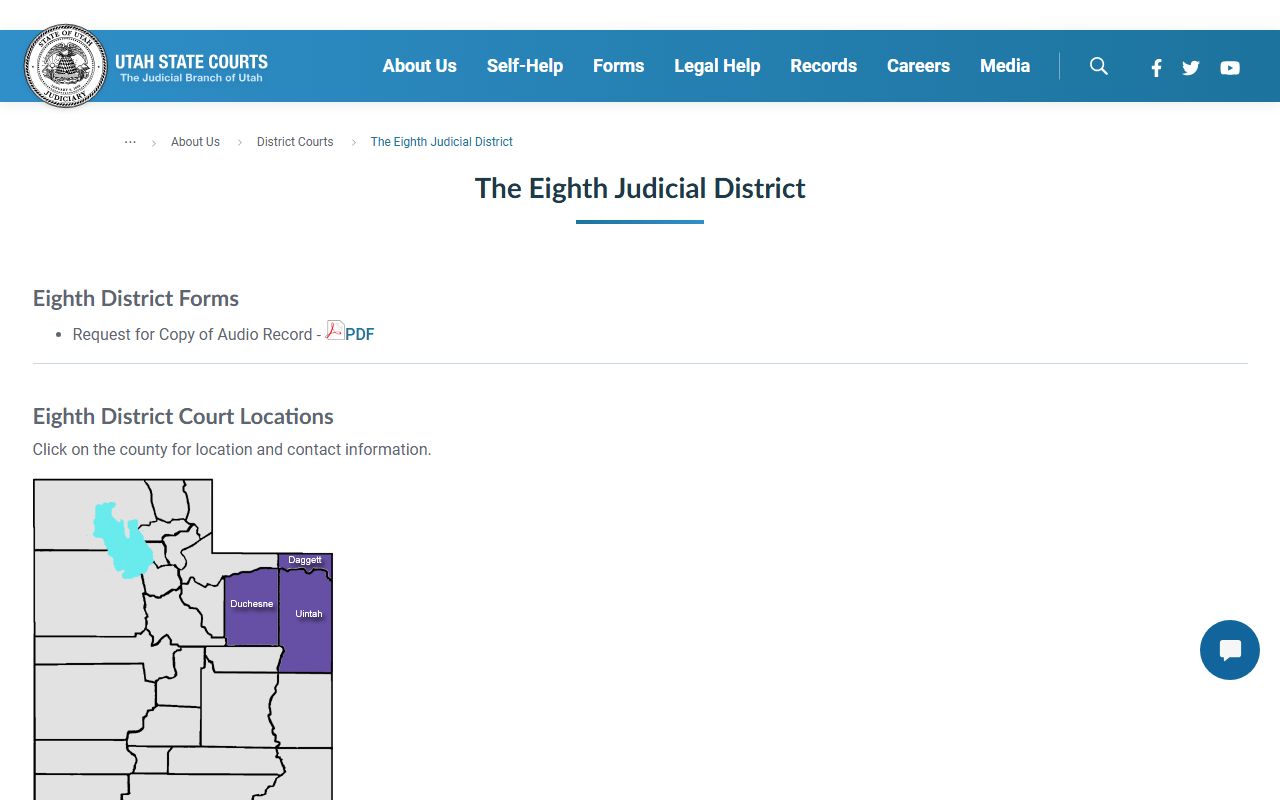
The Eighth Judicial District covers several northeastern Utah counties, including Daggett, Duchesne, and Uintah. Each county has its own courthouse location, and records are kept separately by county. Daggett County case files are maintained at the Manila courthouse and are indexed to that location. Searching for a Daggett County case in a different Eighth District courthouse location will not yield results, as records are not pooled across counties within the district.
For online access, XChange is the most efficient tool for remote searches. The system allows users to search by party name, case number, or other identifying details and returns results from the specific court where the case was filed. This makes it easy to confirm that a Daggett County case is indexed to the Manila courthouse before making any in-person visit. A subscription or per-search fee applies for most full record access, though public terminals at the Manila courthouse provide free access for those who can visit in person.
Copy fees for documents obtained from the clerk's office are standard across all Utah district courts. Certified copies cost more than plain copies and are required for certain legal purposes such as enforcing a court order with another agency. Confirming the current fee schedule with the clerk before submitting a copy request avoids any surprises when payment is due.
Historical Court Records for Daggett County
Daggett County's historical court records at the Utah State Archives are more limited than those of older Utah counties, simply because the county was not created until 1919. It was formed from Uintah County and is the last county established in Utah, giving it a relatively short history compared to counties founded in the 1850s. Any court records from before 1919 for the geographic area that became Daggett County would be found in the Uintah County collection at the Archives rather than the Daggett County collection.
The Utah State Archives is located at 346 South Rio Grande Street, Salt Lake City, UT 84101. The Archives holds historical court records for all Utah counties, and the Daggett County collection begins with the county's founding year. The volume of historical records is more modest than for larger, older counties, but what exists is preserved and available for research. Archives staff can advise on what is available and how to access specific records from the Daggett County collection.
Researchers interested in the earliest decades of Daggett County history should also look at the county's probate and land records from the 1920s through mid-century, as these documents reflect the settlement patterns of this remote northeastern Utah region. Family history researchers tracing ancestors in the Flaming Gorge and Uinta Mountains area may find that records cross the Uintah-Daggett county line depending on the year of the event they are researching.
For researchers who cannot travel to Salt Lake City, the State Archives website provides an overview of available collections and offers some digitized records. FamilySearch.org has also digitized portions of Utah's historical court record collections and makes them available online at no cost. Checking both resources before planning a trip to the Archives can save time and help focus the research visit.
Note: Because Daggett County is relatively new and small, some records from its earliest years may be sparse or may overlap with the Uintah County collection from the same era.
Legal Help for Daggett County Residents
Daggett County residents dealing with family court matters have access to the same statewide legal resources available to all Utah residents. The county's remote location and small size make these online and phone-based resources especially important for people who cannot easily reach a local attorney.
Utah Legal Services provides free civil legal assistance to income-eligible individuals throughout the state, including those in Daggett County. They can help with family law matters such as divorce, child custody and support, and protective orders. Contact Utah Legal Services by phone or through their website to apply and see if you qualify. For Daggett County residents, who may be hours from the nearest private family law attorney, Utah Legal Services can be a vital point of access for legal guidance.
The Utah courts' free forms library at utcourts.gov/forms provides downloadable forms and instructions for common family law proceedings. These forms are updated regularly. Using current versions is important since older forms may no longer conform to the requirements of the Title 81 Domestic Relations Code that took effect in September 2024. The forms library is accessible from any internet connection and does not require a subscription or account.
The court directory at utcourts.gov/courts lists current contact details and hours for the Eighth District Court in Manila and all other Utah courts. Because Daggett County's courthouse may have variable hours, checking this directory before any visit is a practical step that can prevent wasted travel time. The Open Courts Compendium at rcfp.org is also a useful reference for understanding the full scope of public access rights to Utah court records, including family court case files from Daggett County.
Daggett County's setting near Flaming Gorge Reservoir in the Uinta Mountains makes it one of Utah's most scenic and remote counties. Manila, the county seat, is a small community that serves as the center of government and legal activity for the entire county. All family court matters for every resident in Daggett County are handled at the single Eighth District Court location in Manila, making that courthouse the single point of contact for anyone seeking family court records in this northeastern Utah county.